
Печать
ANTI-DHFR, N-TERMINAL
Кат. №: D1067
Производитель: Sigma-Aldrich
Кол-во:
Цена по запросу
Товар оформляется под заказ
Печать
ANTI-DHFR, N-TERMINAL
Кат. №: D1067
Производитель: Sigma-Aldrich
Кол-во:
Цена по запросу
Товар оформляется под заказ
Кол-во:
Цена по запросу
Товар оформляется под заказ
Description_x000D_
General description_x000D_
Dihydrofolate reductase has 187 amino acids and corresponds to molecular weight of 18-20 kDa. It is mapped to chromosome 5q22 region. DHFR contains substrate binding site and coenzyme binding domain._x000D_
Specificity_x000D_
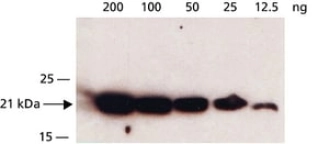
Anti-DHFR, N-terminal antibody is specific for the epitope residing within amino acids of mouse DHFR. The antibody interacts with DHFR and DHFR fusion proteins. The product is specific for DHFR in humans, mice and rats. Staining of the DHFR band by immunoblotting is inhibited by the immunizing peptide._x000D_
Immunogen_x000D_
The immunizing sequence is conserved in mouse, human and rat._x000D_
Application_x000D_
Anti-DHFR, N-terminal antibody produced in rabbit has been used in immunoprecipitation and western blotting._x000D_
Physical form_x000D_
Solution in 0.01 M phosphate buffered saline, pH 7.4, containing 1% bovine serum albumin and 15 mM sodium azide._x000D_
Disclaimer_x000D_
Unless otherwise stated in our catalog or other company documentation accompanying the product(s), our products are intended for research use only and are not to be used for any other purpose, which includes but is not limited to, unauthorized commercial uses, in vitro diagnostic uses, ex vivo or in vivo therapeutic uses or any type of consumption or application to humans or animals._x000D_
Biochem/physiol Actions_x000D_
Dihydrofolate reductase (DHFR) inhibitors, such as methotrexate, are folate analogs which can bind to the active site and deactivate the enzyme. From another angle, structural and enzymatic properties of DHFR led to development of a variety of screenings, in which DHFR can function in a fashion that resembles reporter genes. The screenings are based on the fact that DHFR can be dissected into two halves that can reassemble to form an active enzyme. Thus, each of the two halves of DHFR can be expressed as two fusion proteins that when interacting with each other can restore the DHFR enzymatic activity. The readout of this protein-protein interaction and consequent enzymatic activity, can be either restoration of growth in bacterial, yeast and plant, or receptor activation. The approach was proved to be useful for receptor-ligand, antigen-antibody and other interactions._x000D_
Dihydrofolate reductase (DHFR) is an NADPH dependent enzyme that reduces dihydrofolate and regenerates tetrahydrofolate. DHFR is involved in the biosynthesis of thymidylate and purines, and thereby regulates DNA synthesis and cell survival. Alterations in DHFR have been associated with impaired nucleic acid synthesis and cell death. Thus, this enzyme has important therapeutic implications in cell proliferative disorders such as cancer.
Related Categories
Alphabetical Index, Antibodies, Antibodies for Cell Biology, Antibodies for Cell Cycle, Antibodies to Nucleic Acids and Nucleic Acid Metabolism, Cell Biology, Cell Signaling and Neuroscience, Cell Stress, DE-DL, DNA Repair Proteins and Reagents, Miscellaneous Antibodies, Molecular Biology, Nitric Oxide and Cell Stress, Primary Antibodies, Proteomics, Purification and Detection, Recombinant Protein Expression and AnalysisMore... conjugate
Дорогой клиент, на сайте внедрена нейросеть для сбора информации о товаре. Это может привести к незначительным расхождениям в характеристиках продукции.