Печать
ANTI-GPR39 (C-TERMINAL REGION) , ANTI&
Кат. №: SAB4200185-200UL
Производитель: Sigma-Aldrich
Кол-во:
Цена по запросу
Товар оформляется под заказ
Печать
ANTI-GPR39 (C-TERMINAL REGION) , ANTI&
Кат. №: SAB4200185-200UL
Производитель: Sigma-Aldrich
Кол-во:
Цена по запросу
Товар оформляется под заказ
Кол-во:
Цена по запросу
Товар оформляется под заказ
Description_x000D_
General description_x000D_
GPR39 (G protein-coupled receptor 39) is an orphan member of the ghrelin receptor family expressed in brain and other peripheral tissues._x000D_
The full-length biologically active form of GPR39, called GPR39-1a, is found exclusively in peripheral tissues. A truncated spliced variant of GPR39 is expressed in various regions of the brain. GPR39 mRNA is highly expressed in endocrine and metabolic organs such as the pancreas, liver, the gastrointestinal tract and white adipose tissue. GPR39 expression specifically follows the endocrine pancreatic differentiation and is selectively expressed in β-cells of the pancreatic islets._x000D_
Application_x000D_
Anti-GPR39 (C-terminal region) antibody produced in rabbit has been used in immunohistochemistry._x000D_
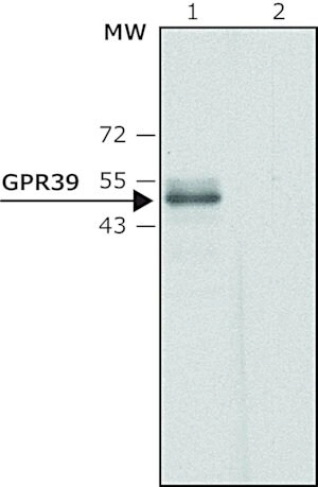
Anti-GPR39 (C-terminal region) antibody produced in rabbit is suitable for western blot at a concentration of 1.5-3.0μg/mL using cell lysates of HEK-293T over expressing human GPR39._x000D_
Physical form_x000D_
Solution in 0.01 M phosphate buffered saline, pH 7.4, containing 15 mM sodium azide._x000D_
Disclaimer_x000D_
Unless otherwise stated in our catalog or other company documentation accompanying the product(s), our products are intended for research use only and are not to be used for any other purpose, which includes but is not limited to, unauthorized commercial uses, in vitro diagnostic uses, ex vivo or in vivo therapeutic uses or any type of consumption or application to humans or animals._x000D_
Biochem/physiol Actions_x000D_
G-protein coupled receptor 39 (GPR39) has been shown to be important regulators of food intake, energy metabolism and glucose homeostasis. GPR39 signals mainly through the Gαq and Gα12/13 leading to inositol phosphate accumulation and activation of downstream pathways such as the nuclear factor of activated T cells (NFAT) transcriptional pathway. GPR39 has been suggested to mediate glutamate metabotropic signaling triggered by synaptically released Zn2+ in the hippocampus. Knockout of GPR39 in mice is found to be associated with impaired insulin secretion, glucose tolerance and altered pancreatic β-cell gene expression and function, suggesting that this receptor could be a novel potential target for the treatment of diabetes._x000D_
GPR39 (G protein-coupled receptor 39) exerts ligand-independent signaling activity. It is mainly involved in the regulation of growth hormone secretion. It facilitates the functional activities of the growth hormone-releasing peptides (GHRPs) and non-peptide ligands such as L-692,429 and MK-0677. It has been studied that zinc ion triggers GPR39 activity during food intake and energy metabolism. Study also shows that GPR39 may control the neuronal activity not only by altering transmitter expression and release but also through altering neuronal plasticity.
Related Categories
Alphabetical Index, Antibodies, Antibodies for Cell Biology, Antibodies to G Proteins, Antibodies to G Proteins and Cyclic Nucleotides, GP-GP, Primary AntibodiesMore... conjugate
Дорогой клиент, на сайте внедрена нейросеть для сбора информации о товаре. Это может привести к незначительным расхождениям в характеристиках продукции.