Печать
ANTI-HUMAN IGG3-PEROXIDASE ANTIBODY, MO&
Кат. №: SAB4200769-1VL
Производитель: Sigma-Aldrich
Кол-во:
Фасовка:
Цена по запросу
Товар оформляется под заказ
Печать
ANTI-HUMAN IGG3-PEROXIDASE ANTIBODY, MO&
Кат. №: SAB4200769-1VL
Производитель: Sigma-Aldrich
Кол-во:
Фасовка:
Цена по запросу
Товар оформляется под заказ
Кол-во:
Фасовка:
Цена по запросу
Товар оформляется под заказ
Description_x000D_
General description_x000D_
Human IgG consist of four subclasses (1-4) that can be recognized by the antigenic difference in their heavy chains. They constitute approximately 65, 30, 5 and 4% of the total IgG, respectively. Each subclass has different biological and physiochemical properties. The IgG subclass may be preferentially produced in response to different antigens and pathological conditions. For instance, anti-polysaccharide responses are mainly of the IgG2 subclass while protein antigens responses give rise to IgG1 and IgG3 antibodies. IgG1 and IgG3 are the only subclasses capable of adherence to mononuclear phagocytes and are recognized readily by the Fc receptors on various reticulo-endothelial cells, while IgG2 and IgG4 are far less efficient. The abundance of the different IgG subclasses in the bloodstream varies with age, IgG1 and IgG3 reach normal adult levels by 5-7 years of age while IgG2 and IgG4 levels rise more slowly, reaching adult levels at about 10 years of age. Serum IgG subclass deficiencies have been recorded for different patient groups. IgG3 deficiency has been associated with a patient’s history of recurrent infectious that may lead to chronic lung disease. Decreased IgG3 levels are frequently associated with IgG1 deficiency. Examination of the distribution pattern of IgG subclasses in different types of diseases may provide insight into the related immunological processes and may assist in the diagnosis of various disorders._x000D_
Immunogen_x000D_
Human IgG3 myeloma proteins covalently coupled to polyaminostyrene (PAS) microbeads_x000D_
Application_x000D_
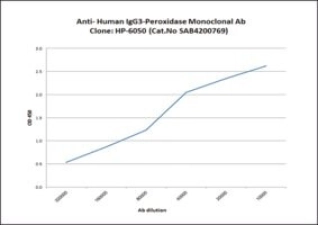
Direct ELISA: a working dilution of 1:80,000-1:160,000 is recommended using 2 μg/mL human IgG3 for coating._x000D_
Physical form_x000D_
Supplied as a lyophilized powder._x000D_
Other Notes_x000D_
In order to obtain best results in different techniques and preparations we recommend determining optimal working concentration by titration test.
Quality Level
200 biological source
Дорогой клиент, на сайте внедрена нейросеть для сбора информации о товаре. Это может привести к незначительным расхождениям в характеристиках продукции.