Печать
Anti-Polo-like kinase-1
Кат. №: ABE2619-25UG
Производитель: Sigma-Aldrich
Кол-во:
Цена по запросу
Товар оформляется под заказ
Печать
Anti-Polo-like kinase-1
Кат. №: ABE2619-25UG
Производитель: Sigma-Aldrich
Кол-во:
Цена по запросу
Товар оформляется под заказ
Кол-во:
Цена по запросу
Товар оформляется под заказ
Description
General description
Serine/threonine-protein kinase PLK1 (UniProt: P53350; also known as EC: 2.7.11.21, Polo-like kinase 1, PLK-1, Serine/threonine-protein kinase 13, STPK13) is encoded by the PLK1 (also known as PLK) gene (Gene ID: 5347) in human. PLK-1 is a serine/threonine-protein kinase that performs several important functions throughout M phase of the cell cycle, including the regulation of centrosome maturation and spindle assembly, the removal of cohesins from chromosome arms, the inactivation of anaphase-promoting complex/cyclosome (APC/C) inhibitors, and the regulation of mitotic exit and cytokinesis. It is shown to express in placenta and colon and its activity is enhanced by growth promoting agents. PLK-1 is activated by phosphorylation at Thr210 by aurora kinase A. It accumulates to a maximum during the G2 and M phases and declines to a nearly undetectable levels following mitosis and throughout G1 phase. However, it begins to accumulate again during the S phase of cell cycle. The kinase domain of PLK-1 is localized to amino acids 53-305 with activation loop in the region of amino acids 194-221. PLK-1 contains 2 POLO box domains (aa 417-480 and 515-584), which act as phosphopeptide-binding module that recognize and bind serine-phosphothreonine/ phosphoserine]-(proline/X) motifs. PLK-1 recognizes and binds docking proteins that are already phosphorylated on these motifs, and then phosphorylates them. Defects in PLK1 gene are associated with some cancers, such as gastric, thyroid or B-cell lymphomas. Expression is shown to be higher in tumor tissues with a poor prognosis, suggesting its role in malignant transformations and carcinogenesis.
Specificity
This rabbit polyclonal antibody detects human Polo-like kinase 1. It targets an epitope within 303 amino acids from the C-terminal half.
Immunogen
Epitope: C-terminus
His-tagged recombinant fragment corresponding to 303 amino acids from the C-terminal half of human Polo-like kinase-1.
Application
Anti-Polo-like kinase-1, Cat. No. ABE2619, is a rabbit polyclonal antibody that detects Polo-Like Kinse 1 and has been tested for use Immunocytochemistry, Immunofluorescence, Immunoprecipitation, and Western Blotting.
Immunofluorescence Analysis: A representative lot detected Polo-like kinase-1 in U2OS cells (Macurek, L., et. al. (2008). Nature. 455(7209):119-23).
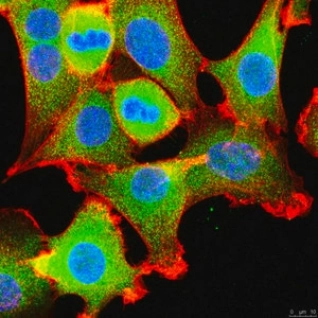
Immunocytochemistry Analysis: A 1:1,000 dilution from a representative lot detected Polo-like kinase-1 in U2OS and C2C12 cells.
Western Blotting Analysis: A representative lot detected Polo-like kinase-1 in U2OS-TR transfected cells (Macurek, L., et. al. (2008). Nature. 455(7209):119-23).
Immunoprecipitation Analysis: A representative lot detected Polo-like kinase-1 in U2OS-TR transfected cells (Macurek, L., et. al. (2008). Nature. 455(7209):119-23).
Research Category
Signaling
Target description
~68 kDa observed; 68.26 kD calculated. Uncharacterized bands may be observed in some lysate(s).
Physical form
Affinity Purified
Format: Purified
Purified rabbit polyclonal antibody in PBS containing 80 mM Glycine with 0.1% sodium azide.
Storage and Stability
Stable for 1 year at 2-8°C from date of receipt.
Disclaimer
Unless otherwise stated in our catalog or other company documentation accompanying the product(s), our products are intended for research use only and are not to be used for any other purpose, which includes but is not limited to, unauthorized commercial uses, in vitro diagnostic uses, ex vivo or in vivo therapeutic uses or any type of consumption or application to humans or animals.
Quality
Evaluated by Western Blotting in U2OS transfected with PLK1 siRNA and U2OS transfected with control oligo (LUC o Luciferase).
Western Blotting Analysis: 0.5 µg/mL of this antibody detected Polo-like kinase-1 in U2OS transfected with PLK1 siRNA (PLK1) & U2OS transfected with control oligo (LUC o Luciferase).
Other Notes
Concentration: Please refer to lot specific datasheet.
Related Categories
Alphabetical Index, Antibodies, POD-POZ, Primary Antibodies clone
Дорогой клиент, на сайте внедрена нейросеть для сбора информации о товаре. Это может привести к незначительным расхождениям в характеристиках продукции.