Печать
ANTI-RACK1 (N-TERMINAL)
Кат. №: R1905-200UL
Производитель: Sigma-Aldrich
Кол-во:
Цена по запросу
Товар оформляется под заказ
Печать
ANTI-RACK1 (N-TERMINAL)
Кат. №: R1905-200UL
Производитель: Sigma-Aldrich
Кол-во:
Цена по запросу
Товар оформляется под заказ
Кол-во:
Цена по запросу
Товар оформляется под заказ
Description_x000D_
General description_x000D_
Receptors for activated C-kinase (RACKs) are scaffold protein for Protein kinase C (PKC). It is composed of seven WD (Trp-Asp) repeats, thus resembling the structure of the subunit of G proteins._x000D_
Specificity_x000D_
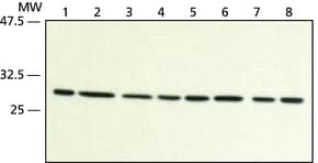
Anti-RACK1 (N-terminal) is produced in rabbit and specifically recognizes human RACK1. Anti-RACK1 (N-terminal) antibody is specific for human RACK1 (approx. 30 kDa). The antibody also reacts with rat and mouse RACK1. In immunoblotting, staining of the RACK1 band is specifically inhibited by the immunizing peptide._x000D_
Immunogen_x000D_
synthetic peptide corresponding to amino acids 2-16 of human RACK1, conjugated to KLH via an C-terminal added cysteine residue. The corresponding sequence is conserved in human, rat and mouse._x000D_
Application_x000D_
Anti-RACK1 (N-terminal) antibody is suitable for use in indirect immunofluorescence (1:100-1:200 using paraformaldehyde-fixed HeLa cells), western blot (1:500-1:1,000 using HEK-293T cell lysates) and immunoprecipitation (5-10 μL using HEK-293T cell lysates)._x000D_
It is also used in immunoblotting._x000D_
Physical form_x000D_
Solution in 0.01 M phosphate buffered saline, pH 7.4, containing 15 mM sodium azide._x000D_
Disclaimer_x000D_
Unless otherwise stated in our catalog or other company documentation accompanying the product(s), our products are intended for research use only and are not to be used for any other purpose, which includes but is not limited to, unauthorized commercial uses, in vitro diagnostic uses, ex vivo or in vivo therapeutic uses or any type of consumption or application to humans or animals._x000D_
Biochem/physiol Actions_x000D_
RACK1 is a receptor for activated C kinases that functions downstream of the growth factor receptor signaling pathway. RACK1 also modulates several functions such as cell adhesion, chemotaxis and protrusion. Increased RACK1 expression has been associated with cell migration and metastasis in breast carcinoma. Thus, RACK1 can be used as a prognostic indicator for breast cancer_x000D_
Receptors for activated C-kinase (RACKs) anchor activated Protein kinase C (PKC) at the site of translocation. Receptors for activated C-kinase 1 (RACK1) is the selective RACK for PKC-βII. RACK1 anchors other signaling enzymes such as Sarcoma (Src) tyrosine kinase, integrin and phosphodiesterase 4D5. The ability of RACK1 to interact simultaneously with different signaling molecules, allows it to integrate inputs from distinct signaling pathways. Accumulating evidence attributes to it the role of regulating several major nervous system pathways. RACK1 is a ribosomal protein and can make direct contact with ribosomal RNA. It recruits activated PKC to the ribosome, which in turn, phosphorylates initiation factor 6, leading to ribosome assembly.
Related Categories
Alphabetical Index, Antibodies, Antibodies for Cell Biology, Antibodies for Kinase/Phosphatase Biology, Non-Receptor Tyrosine Kinase Adaptor Protein Antibodies, Primary Antibodies, RAB-RAD, RACK ProteinsMore... conjugate
Дорогой клиент, на сайте внедрена нейросеть для сбора информации о товаре. Это может привести к незначительным расхождениям в характеристиках продукции.