Печать
ANTI-SIRT1
Кат. №: S5447-200UL
Производитель: Sigma-Aldrich
Кол-во:
Цена по запросу
Товар оформляется под заказ
Печать
ANTI-SIRT1
Кат. №: S5447-200UL
Производитель: Sigma-Aldrich
Кол-во:
Цена по запросу
Товар оформляется под заказ
Кол-во:
Цена по запросу
Товар оформляется под заказ
Description_x000D_
General description_x000D_
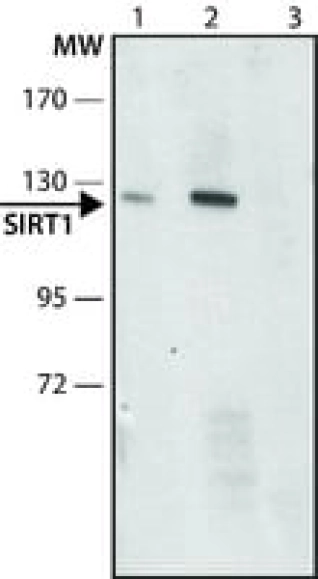
Anti-SIRT1 recognizes human SIRT1. Sirtuin 1 (SIRT1) is encoded by the gene mapped to human chromosome 10q21.3. The encoded protein belongs to the silent information regulator (SIR) family and is a class of HDAC (histone deacetylase). SIRT1 is expressed in various tissues including brain, liver, pancreas, adipose tissue, and skeletal muscle. SIRT1 is also known as the longevity gene._x000D_
Immunogen_x000D_
synthetic peptide corresponding to amino acids 580-593 of human SIRT1, conjugated to KLH via an N-terminal cysteine residue. The corresponding sequence differs by three amino acids in rat and mouse Sirt1._x000D_
Application_x000D_
Anti-SIRT1 antibody produced in rabbit has been used in immunohistochemistry._x000D_
Physical form_x000D_
Solution in 0.01 M phosphate buffered saline, pH 7.4, containing 15 mM sodium azide._x000D_
Storage and Stability_x000D_
For continuous use, store at 2-8°C for up to one month. For extended storage, freeze in working aliquots. Repeated freezing and thawing, or storage in “frostfree” freezers, is not recommended. If slight turbidity occurs upon prolonged storage, clarify the solution by centrifugation before use. Working dilutions should be discarded if not used within 12 hours._x000D_
Disclaimer_x000D_
Unless otherwise stated in our catalog or other company documentation accompanying the product(s), our products are intended for research use only and are not to be used for any other purpose, which includes but is not limited to, unauthorized commercial uses, in vitro diagnostic uses, ex vivo or in vivo therapeutic uses or any type of consumption or application to humans or animals._x000D_
Biochem/physiol Actions_x000D_
Sirtuin 1 (SIRT1) functions as a regulator of various metabolic pathways, and influences the pathophysiology of several metabolic diseases. It is a regulator of protein deacetylation, and is a candidate therapeutic target in non-alcoholic fatty liver disease (NAFLD), amyotrophic lateral sclerosis (ALS), kidney disease, and pulmonary disease. It also participates in tumorigenesis, and whether it functions as an oncogene or as a tumor suppressor depends upon the tumor type. In pancreatic ductal adenocarcinoma (PDAC), its elevated expression is linked with poor prognosis, and in non-small-cell lung cancer (NSCLC), it suppresses the expression of tumor suppressor p27. The encoded protein inhibits the terminal differentiation in dividing myocytes by binding to the myoD cofactor, pCAF. It is also thought to function as a suppressor of cardiovascular disorders, such as myocardial infarction, or neurodegenerative diseases, such as Alzheimer’s disease (AD) or Parkinson’s disorder (PD)._x000D_
Other Notes_x000D_
In order to obtain the best results using various techniques and preparations, we recommend determining the optimal working dilutions by titration.
Related Categories
Alphabetical Index, Antibodies, Antibodies for Cell Biology, Antibodies for Epigenetics and Nuclear Signaling, Antibodies for Gene Regulation, Antibodies for Gene Regulation and Expression, Antibodies in Chromatin Remodeling, Antibodies to Chromatin, Antibodies to Modifying Enzymes/Histone Deacetylase, Antibodies to Most Studied Epigenetic Genes, Antibodies to Transcription Factors, Antibodies to Transcription Regulators, Primary Antibodies, RF - SO, SG-SKMore... conjugate
Дорогой клиент, на сайте внедрена нейросеть для сбора информации о товаре. Это может привести к незначительным расхождениям в характеристиках продукции.