Печать
ANTI-WRN ANTIBODY, MOUSE MONOCLONAL, CL&
Кат. №: W0393-200UL
Производитель: Sigma-Aldrich
Кол-во:
Цена по запросу
Товар оформляется под заказ
Печать
ANTI-WRN ANTIBODY, MOUSE MONOCLONAL, CL&
Кат. №: W0393-200UL
Производитель: Sigma-Aldrich
Кол-во:
Цена по запросу
Товар оформляется под заказ
Кол-во:
Цена по запросу
Товар оформляется под заказ
Description_x000D_
General description_x000D_
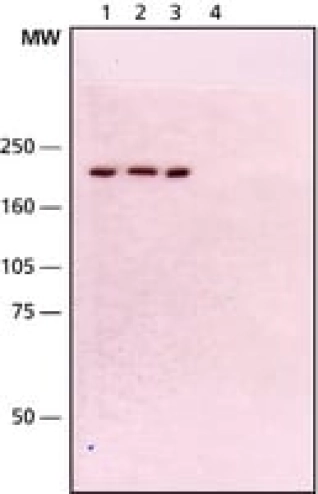
Anti-WRN antibody, Mouse monoclonal, (mouse IgG1 isotype) is derived from the hybridoma 195C produced by the fusion of mouse myeloma cells (p3-NS1/Ag4-1) and splenocytes from BALB/c mice immunized with a recombinant fusion protein fragment of human WRN. Werner syndrome ATP-dependent helicase (WRN) is located on chromosome 8 and is 167 kDa. The WRN protein belongs to the RecQ helicase family of DNA helicases._x000D_
Immunogen_x000D_
recombinant fusion protein fragment of human WRN (amino acids 1074-1432)._x000D_
Application_x000D_
Anti-WRN antibody has been used in_x000D_
• enzyme linked immunosorbent assay (ELISA)_x000D_
• immunoblotting_x000D_
• immunoprecipitation_x000D_
• immunohistochemistry_x000D_
• western blotting_x000D_
Physical form_x000D_
Solution in 0.01 M phosphate buffered saline, pH 7.4, containing 15 mM sodium azide._x000D_
Disclaimer_x000D_
Unless otherwise stated in our catalog or other company documentation accompanying the product(s), our products are intended for research use only and are not to be used for any other purpose, which includes but is not limited to, unauthorized commercial uses, in vitro diagnostic uses, ex vivo or in vivo therapeutic uses or any type of consumption or application to humans or animals._x000D_
Biochem/physiol Actions_x000D_
Werner syndrome ATP-dependent helicase (WRN) protein has been demonstrated to possess three known catalytic activities: 3′-5′ helicase, exonuclease and ATPase activities. The C-terminal region of the protein contains a nuclear localization signal (NLS), thus targeting WRN protein to the nucleus, nucleolus and nucleoplasmic foci. The involvement of WRN in multiple DNA metabolic process suggests its function as a tumor suppressor. Mutations in the WRN protein results in Werner syndrome (WS). The epigenetic inactivation of WRN leads to loss of WRN-exonuclease activity, resulting in increased chromosomal instability and hypersensitivity to chemotherapeutic drugs.
Related Categories
Alphabetical Index, Antibodies, Antibodies for Cell Biology, Antibodies for Cell Stress, Antibodies to DNA Repair Proteins, Primary Antibodies, WMore... conjugate
Дорогой клиент, на сайте внедрена нейросеть для сбора информации о товаре. Это может привести к незначительным расхождениям в характеристиках продукции.