Печать
Anti-ZO-1
Кат. №: AB2272-25UG
Производитель: Sigma-Aldrich
Кол-во:
Цена по запросу
Товар оформляется под заказ
Печать
Anti-ZO-1
Кат. №: AB2272-25UG
Производитель: Sigma-Aldrich
Кол-во:
Цена по запросу
Товар оформляется под заказ
Кол-во:
Цена по запросу
Товар оформляется под заказ
Description
General description
Tight junctions are complexes of proteins that create intercellular boundaries between the plasma membrane domains of epithelial and endothelial cells. Many of the tight junction-associated proteins are members of the membrane associated guanylate kinase (MAGUK) family and include occludin and zona occludin family members ZO-1, ZO-2 and ZO-3. These proteins are thought to have both structural and signaling roles, and are characteristically defined by three protein-protein interaction modules: the PDZ domain, the SH3 domain and the guanylate kinase (GuK) domain. ZO-1 forms complexes with either ZO-2 or ZO-3. In addition, these proteins can also associate with claudin, occludin and F-actin, at tight junction stands, where they provide a linkage between the actin cytoskeleton and the tight junction. ZO-1 expression is significantly reduced in many breast cancer lines. ZO-2 and ZO-3 are ubiquitously expressed within epithelial tight junctions, and unlike ZO-1, which is also expressed at cell junctions of cardiac myocytes, ZO-2 is not expressed in nonepithelial tissue.
Specificity
Other homologies: Rat ( 89% sequence homology).
Immunogen
KLH-conjugated linear peptide corresponding to human ZO-1.
Application
Detect ZO-1 using this Anti-ZO-1 Antibody validated for use in WB, IH(P).
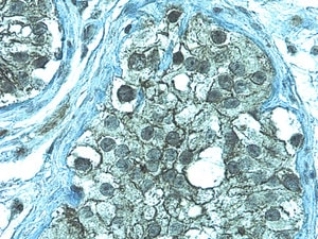
Immunohistochemistry Analysis: 1:500 dilution from a previous lot detected ZO-1 in normal human testis tissue.
Research Category
Neuroscience
Research Sub Category
Neuronal & Glial Markers
Target description
~260 kDa observed
Physical form
Affinity Purfied
Purified rabbit polyclonal in buffer containing 0.1 M Tris-Glycine (pH 7.4), 150 mM NaCl with 0.05% sodium azide.
Storage and Stability
Stable for 1 year at 2-8°C from date of receipt.
Disclaimer
Unless otherwise stated in our catalog or other company documentation accompanying the product(s), our products are intended for research use only and are not to be used for any other purpose, which includes but is not limited to, unauthorized commercial uses, in vitro diagnostic uses, ex vivo or in vivo therapeutic uses or any type of consumption or application to humans or animals.
Quality
Evaluated by Western Blot in HepG2 cell lysate.
Western Blot Analysis: 0.1 µg/mL of this antibody detected ZO-1 on 10 µg of HepG2 cell lysate.
Analysis Note
Control
HepG2 cell lysate
Other Notes
Concentration: Please refer to lot specific datasheet.
Concentration: Please refer to the Certificate of Analysis for the lot-specific concentration.
Related Categories
Alphabetical Index, Antibodies, Primary Antibodies, ZP-ZZ clone
Дорогой клиент, на сайте внедрена нейросеть для сбора информации о товаре. Это может привести к незначительным расхождениям в характеристиках продукции.