Печать
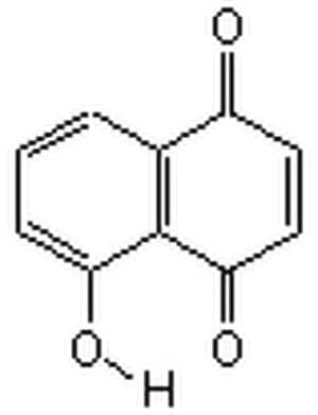
Juglone 1PC X 250MG
Кат. №: 420120-250MG
Производитель: Sigma-Aldrich
Кол-во:
Цена по запросу
Товар оформляется под заказ
Печать
Juglone 1PC X 250MG
Кат. №: 420120-250MG
Производитель: Sigma-Aldrich
Кол-во:
Цена по запросу
Товар оформляется под заказ
Кол-во:
Цена по запросу
Товар оформляется под заказ
Description
General description
A highly selective cell-permeable, irreversible inhibitor of PPlases (peptidyl-prolyl cis/trans isomerases of the parvulin family). Other known PPlase inhibitors such as cyclosporin A, FK506, and rapamycin are not reported to inhibit the parvulin family of PPlases. The inactivation is shown to occur via the addition of thiol groups to juglone and not by any redox process. Exhibits bacteriostatic and fungistatic effects. Reported to be cytotoxic towards eukaryotic cells and to block transcription by RNA polymerase II.
Originally isolated from the fruit shells and leaves of walnut trees, juglone is a highly selective, cell permeable, irreversible inhibitor of the parvulin family of peptidyl-prolyl cis/trans isomerases (PPIase). Functions by covalently modifying sulfhydryl groups in the target enzymes. Exhibits bacteriostatic and fungistatic properties as well as cytotoxicity in eukaryotic cells. Also reported to directly block transcription in eukaryotic cells by RNA polymerase I, II, and III as determined by nuclear run-off (IC50 = 7 µM, 7 µM, and 2 µM, respectively). Disrupts formation of functional pre-initiation complexes via modification of sulhydryl groups, but does not significantly affect initiation or elongation. Does not inhibit restriction endonucleases or T7 RNA polymerase.
Packaging
250 mg in Alu drum
Biochem/physiol Actions
Cell permeable: yes
Primary Target
PPlases (peptidyl-prolyl cis/trans isomerases of the parvulin family)
Product does not compete with ATP.
Reversible: no
Packaging
Packaged under inert gas
Warning
Toxicity: Toxic (F)
Reconstitution
Following reconstitution aliquot and freeze (-20°C). Stock solutions are stable for up to 6 months at -20°C.
Other Notes
Chao, S.H., et al. 2001. Nucleic Acids Res.29, 767.
Hennig, L., et al. 1998. Biochemistry37, 5953.
Due to the nature of the Hazardous Materials in this shipment, additional shipping charges may be applied to your order. Certain sizes may be exempt from the additional hazardous materials shipping charges. Please contact your local sales office for more information regarding these charges.
Related Categories
Cell Biology, Cell Signaling and Neuroscience, Immune Cell Signaling and Blood, Immune System Regulation, Immunomodulators and Antibiotics More... Quality Level
Дорогой клиент, на сайте внедрена нейросеть для сбора информации о товаре. Это может привести к незначительным расхождениям в характеристиках продукции.