Печать
Membrane Scaffold Protein 1E3D1 D73C
Кат. №: MSP09-5MG
Производитель: Sigma-Aldrich
Кол-во:
Фасовка:
Цена по запросу
Товар оформляется под заказ
Печать
Membrane Scaffold Protein 1E3D1 D73C
Кат. №: MSP09-5MG
Производитель: Sigma-Aldrich
Кол-во:
Фасовка:
Цена по запросу
Товар оформляется под заказ
Кол-во:
Фасовка:
Цена по запросу
Товар оформляется под заказ
Description_x000D_
General description_x000D_
Nanodisc technology is an approach to render membrane proteins soluble in aqueous solutions in a native-like bilayer environment, where the membrane proteins remain stable and active. The Nanodisc concept is derived from high density lipoprotein (HDL) particles and their primary protein component, apolipoprotein. The Nanodisc is a non-covalent structure of phospholipid bilayer and membrane scaffold protein (MSP), a genetically engineered protein, which mimics the function of Apolipoprotein A-1 (ApoA-1)._x000D_
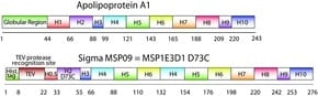
The first MSP, MSP1, was engineered with its sequence based on the sequence of A-1, but without the globular N-terminal domain of native A-1. The MSP1E3D1 D73C variant of MSP1 differs from MSP1 in the following facets:_x000D_
• It deletes the first 11 amino acids in the Helix 1 portion (referred to as “H0.5” in the accompanying figure) of the original MSP1 sequence3 (which is known separately as MSP1D1)._x000D_
• It repeats the Helix 4 (H4), Helix 5 (H5) and Helix 6 (H6) sequences of the original MSP1 sequence between the parent Helix 6 (H6) and Helix 7 (H7) segments of MSP1D1._x000D_
• It substitutes a cysteine (C) residue for an aspartic acid (D) residue in the Helix 2 (H2) portion of the protein, at position 73 of the original native A-1 sequence._x000D_
• The initial histidine-tag is one amino acid shorter._x000D_
Application_x000D_
For guidelines on the use of this and other MSP′s to prepare Nanodiscs, please visit our Protocols for Membrane Scaffold Proteins and Nanodisc Formation page._x000D_
Legal Information_x000D_
Nanodisc technology, and many of its uses, are covered by the following patents held by the University of Illinois._x000D_
• 7,691,414 Membrane scaffold proteins_x000D_
• 7,662,410 Membrane scaffold proteins and embedded membrane proteins_x000D_
• 7,622,437 Tissue factor compositions and methods_x000D_
• 7,592,008 Membrane scaffold proteins_x000D_
• 7,575,763 Membrane scaffold proteins and tethered membrane proteins_x000D_
• 7,083,958 Membrane scaffold proteins_x000D_
• 7,048,949 Membrane scaffold proteins
Related Categories
Biochemicals and Reagents, Membrane Scaffold Proteins, Nanodisc Reagents for Membrane Protein Research, Proteins and Derivatives Quality Level
Дорогой клиент, на сайте внедрена нейросеть для сбора информации о товаре. Это может привести к незначительным расхождениям в характеристиках продукции.