Печать
MONOCLONAL ANTI-DIMETHYL-HISTONE H3&
Кат. №: SAB4200609-200UL
Производитель: Sigma-Aldrich
Кол-во:
Цена по запросу
Товар оформляется под заказ
Печать
MONOCLONAL ANTI-DIMETHYL-HISTONE H3&
Кат. №: SAB4200609-200UL
Производитель: Sigma-Aldrich
Кол-во:
Цена по запросу
Товар оформляется под заказ
Кол-во:
Цена по запросу
Товар оформляется под заказ
Description_x000D_
General description_x000D_
Monoclonal Anti-diMethyl-Histone H3 (diMe-Lys9) (H3K9me2) (mouse IgG1 isotype) is derived from the hybridoma 5E5-G5 produced by the fusion of mouse myeloma cells and splenocytes from BALB/c mice immunized with a dimethylated (diMe-Lys9) peptide corresponding to the N-terminus of human histone H3, conjugated to KLH. Histones H3 and H4 are the core histones forming nucleosome, which is the fundamental unit of chromatin. H3 and H4 remodified by methylation and are highly methylated in mammalian cells._x000D_
Immunogen_x000D_
dimethylated (diMe-Lys9) peptide corresponding to the N-terminus of human histone H3, conjugated to KLH. The isotype is determined by ELISA using Mouse Monoclonal Antibody Isotyping Reagents (Sigma ISO-2)._x000D_
Application_x000D_
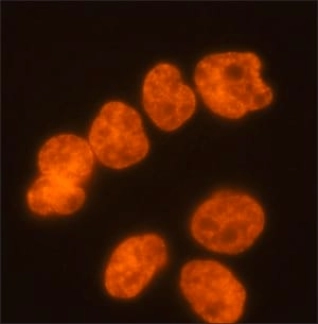
Monoclonal Anti-diMethyl-Histone H3 (diMe-Lys9) (H3K9me2) antibody produced in mouse may be used in several immunochemical techniques including immunoblotting (~17 kDa) and immunofluorescence._x000D_
Physical form_x000D_
Solution in 0.01 M phosphate buffered saline, pH 7.4, containing 15 mM sodium azide._x000D_
Disclaimer_x000D_
Unless otherwise stated in our catalog or other company documentation accompanying the product(s), our products are intended for research use only and are not to be used for any other purpose, which includes but is not limited to, unauthorized commercial uses, in vitro diagnostic uses, ex vivo or in vivo therapeutic uses or any type of consumption or application to humans or animals._x000D_
Biochem/physiol Actions_x000D_
Histones are subjected to extensive covalent modifications, including phosphorylation, methylation, acetylation and ubiquitination thought to play an important role in development and in cancer. Histone methylation, is a complex, dynamic process involving various biological processes including transcriptional regulation, chromatin condensation, mitosis and heterochromatin assembly. Moreover, lysine residues can be mono-, di-, and tri-methylated, adding further complexity to the regulation of chromatin structure. Conserved lysine residues in the N-terminal tail domains of histone H3, Lys4, Lys9 and Lys27 are the preferred sites of methylation. Methylation of H3 at Lys9 is a modification intrinsically linked to epigenetic silencing and heterochromatin assembly.
Related Categories
Alphabetical Index, Antibodies, Antibodies for Epigenetics and Nuclear Signaling, Antibodies for Gene Regulation, DE-DL, Primary AntibodiesMore... conjugate
Дорогой клиент, на сайте внедрена нейросеть для сбора информации о товаре. Это может привести к незначительным расхождениям в характеристиках продукции.