Печать
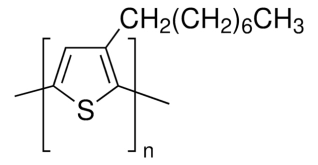
POLY(3-OCTYLTHIOPHENE-2,5-DIYL), REGIO-&
Кат. №: 445711-1G
Производитель: Sigma-Aldrich
Кол-во:
Цена по запросу
Товар оформляется под заказ
Печать
POLY(3-OCTYLTHIOPHENE-2,5-DIYL), REGIO-&
Кат. №: 445711-1G
Производитель: Sigma-Aldrich
Кол-во:
Цена по запросу
Товар оформляется под заказ
Кол-во:
Цена по запросу
Товар оформляется под заказ
Description
General description
Poly(3-octylthiophene-2,5-diyl) (P3OT) is an alkylthiophene based conductive polymer with high electroluminescence, which is soluble in most of the organic solvents. It can be prepared by the electrochemical polymerization of 3-octylthiophene (3OT). It is hydrophobic and can be used as a transducer for ion selective electrodes.
Application
For the characterization and solid-state properties of this polymer, see J. Am. Chem. Soc. .
P3OT forms a nanocomposite with carbon nanotubes (CNTs) for devising a high performance semiconducting material. It can also be used as a π-conjugating polymer for the fabrication of organic electronic based devices which include polymeric diodes, solar cells and photovoltaic modules.
Rechargeable battery electrodes, electrochromic devices, chemical and optical sensors, light-emitting diodes, microelectrical amplifiers, field-effect transistors and non-linear optical materials. Poly (3-octylthiophene-2,5-diyl) (P3OT)-single walled carbon nanotubes composites were prepared., 3 Doped P3OT may be used in NO2 sensing applications. 2
Rechargeable battery electrodes, electrochromic devices, chemical and optical sensors, light-emitting diodes, microelectrical amplifiers, field-effect transistors and non-linear optical materials.
Conducting polymer.
Rechargeable battery electrodes, electrochromic devices, chemical and optical sensors, light-emitting diodes, microelectrical amplifiers, field-effect transistors and non-linear optical materials.
Used in organic field-effect transistors and in polymer-based solar cells.
Packaging
1 g in glass bottle
Features and Benefits
Good processability, environmental stability and electroactivity.
Packaging
Packaged in glass bottles
Legal Information
Product of Rieke Metals, Inc.
Rieke is a registered trademark of Rieke Metals, Inc.
Related Categories
π-Conjugated Polymers, Bioelectronics, Biosensing and Bioimaging, Conductive Polymers, Light-Emitting Polymers (LEPs),
Materials Science, OLED and PLED Materials, Organic Field Effect Transistor (OFET) Materials, Organic and Printed Electronics, P3AT, Poly(3-alkylthiophene) (P3AT) and Other Polythiophenes (PT), Polymer Science, Polymers, Polythiophene Polymers and Co-Polymers, Polythiophenes (PT) and Copolymers, Transducer Materials, p-Type Organic Semiconductors, p-Type Polymers
More... Quality Level
Дорогой клиент, на сайте внедрена нейросеть для сбора информации о товаре. Это может привести к незначительным расхождениям в характеристиках продукции.